
2026-09-14 ·
Preventing Mold Regrowth After Attic Repairs In Lynnwood
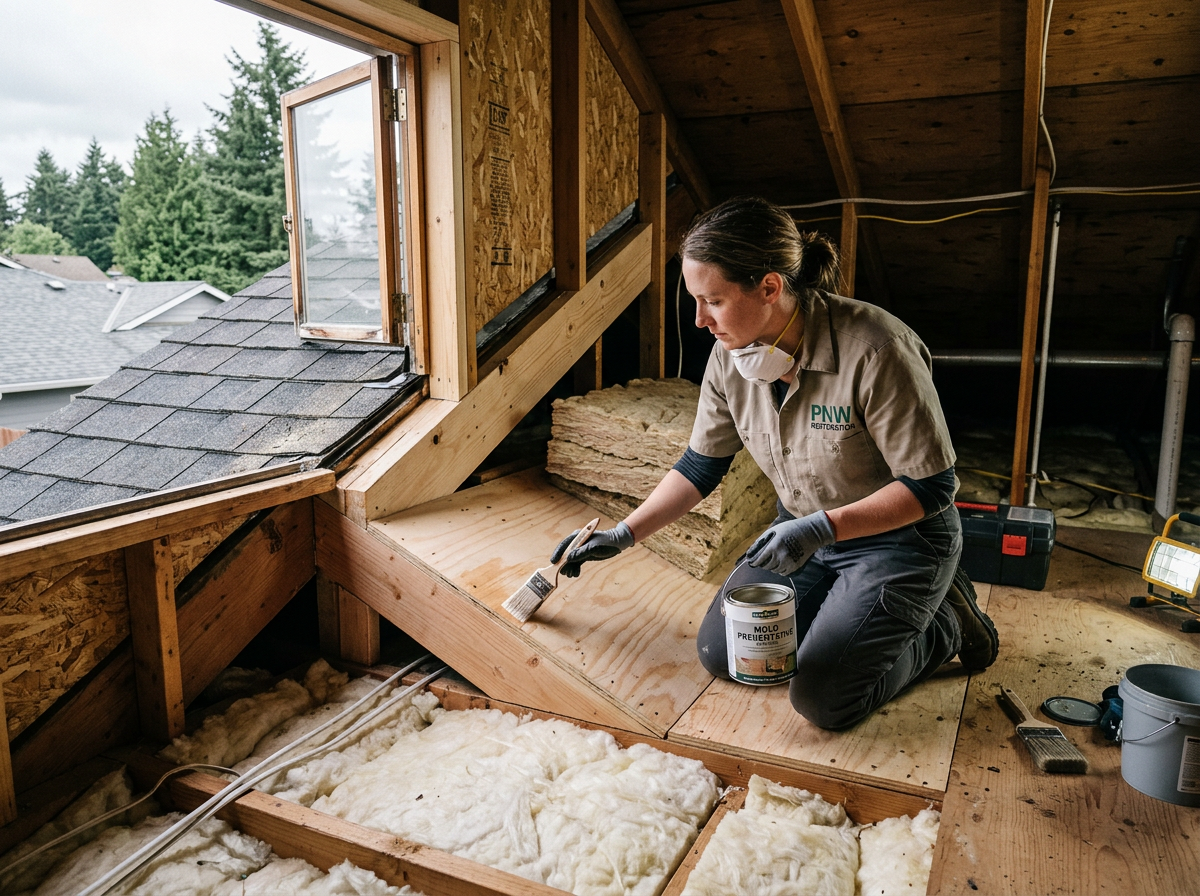
Preventing mold regrowth after attic repairs in Lynnwood requires correcting the ventilation shortfalls that trap moisture against roof sheathing and insulation. In homes west of the Cascades, nine months of maritime damp air combine with common installation errors such as fans vented directly into attics, insulation covering eaves, and blocked soffits. These conditions allow condensation to form on the north slope even after visible growth is removed. Without source correction, spores that remain in dust or on wood surfaces can restart the cycle once humidity rises again.
Correcting Airflow Before Re-Insulation
Begin by confirming that every bath fan, dryer vent, and kitchen exhaust terminates through the roof or an exterior wall rather than into the attic. Check that soffit vents remain clear for at least 12 inches behind the fascia and that ridge or gable vents provide continuous exhaust. In Lynnwood neighborhoods with single-story homes built in the 1970s and 1980s, many attics were insulated without baffles, so cold air cannot reach the underside of the sheathing. Install baffles that maintain a 1-inch minimum air channel from soffit to ridge before adding new insulation. This step restores the stack effect that moves moist air outward instead of letting it linger against wood surfaces.
Managing Ground Moisture and the Stack Effect
Bare-soil crawl spaces beneath Lynnwood homes push humid air upward through ceiling penetrations and electrical boxes. Seal the soil with a 6-mil vapor barrier overlapped 12 inches at seams and taped to foundation walls. Once the crawl is isolated, seal attic bypasses with foam or caulk so conditioned air no longer leaks upward and raises attic humidity. These two actions together reduce the moisture load that previously allowed mold to reappear on the north slope after cleaning alone. Homeowners can verify progress with a simple humidity meter placed in the attic during winter months when outdoor air is coldest.
Ongoing Checks After Repairs
Schedule a follow-up inspection six months after new insulation is installed to confirm that temperatures on the sheathing stay above the dew point. Compare readings taken on the north and south slopes; a difference greater than 5 degrees often signals remaining airflow restrictions. Review the related article How To Check Your Attic For Mold In Lynnwood Homes for a repeatable checklist that uses only a flashlight and moisture meter. If insulation removal was part of the original project, the post Safe Removal Of Contaminated Insulation From Lynnwood Attics outlines how to prevent dust from settling back into the space. For properties that also show moisture issues below grade, the service page Moisture Control and Prevention explains additional steps that complement attic work. Consistent attention to these mechanical details keeps the attic dry without repeated remediation.
Addressing Eastern Washington Conditions
East of the Cascades the climate is drier, yet mechanical failures still create localized moisture. Leaking supply ducts, bathroom fans routed into attics, and ice dams on north-facing roofs can produce enough condensation for regrowth even when outdoor humidity is low. After repairs, verify that all duct joints are sealed with mastic and that fan ducts exit through the roof. In these arid zones the same ventilation corrections apply, though the priority shifts from maritime damp to stopping indoor moisture sources from reaching the attic plane.