
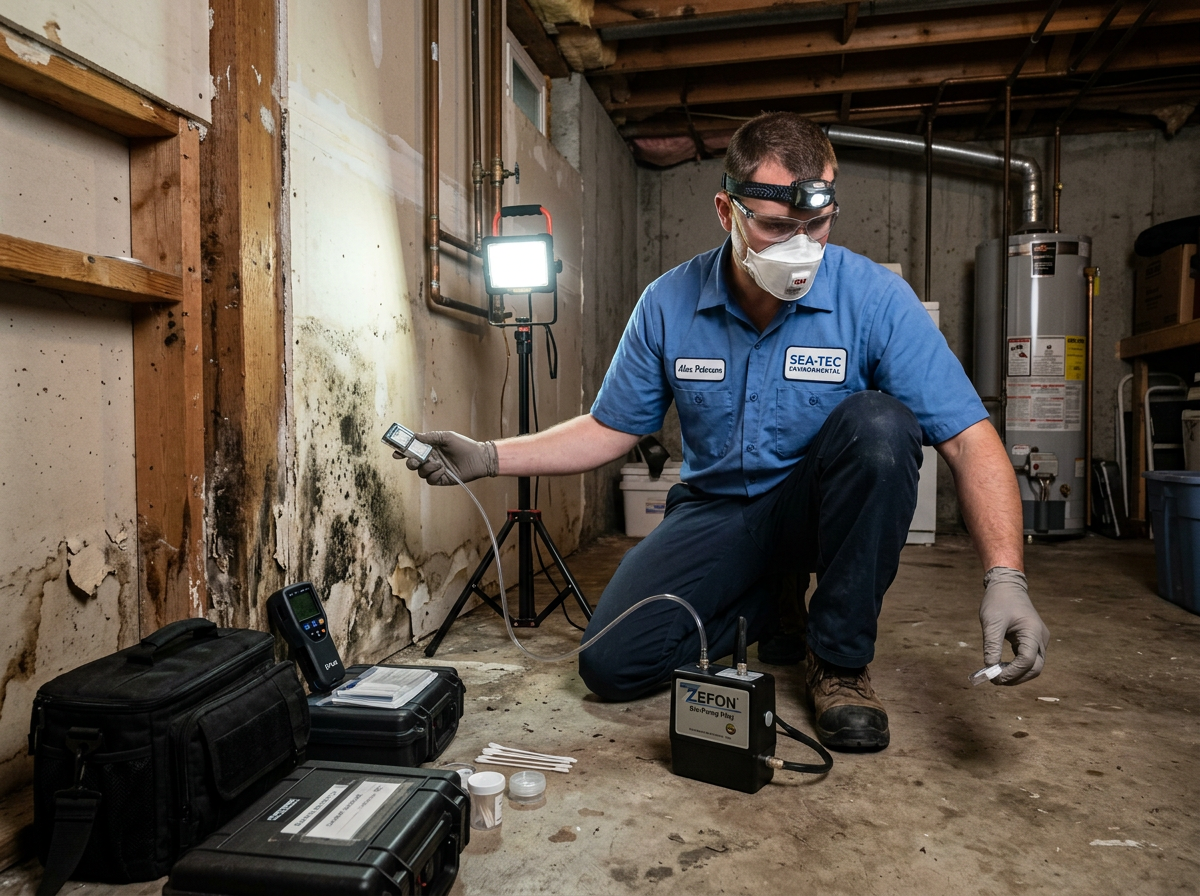
Washington homes west of the Cascades often show attic mold on the north slope of roof sheathing because bath and dryer fans terminate inside the attic while insulation blocks soffit vents. A proper inspection starts with a visual walk-through followed by moisture-meter readings on sheathing, framing, and subfloor rather than jumping straight to air samples. When growth is plainly visible on stained plywood or joists, additional testing rarely changes the remediation plan and can add unnecessary cost.
East of the Cascades the picture shifts to plumbing leaks or over-humidification in arid conditions, so inspectors check behind appliances and in wall cavities where stack effect pulls moisture upward from bare-soil crawl spaces. Meter readings at multiple elevations reveal whether the floor system is feeding humidity into living areas. Homeowners in Lynnwood frequently discover that blocked eave baffles or insulation stuffed over intake vents created the damp conditions long before any visible spots appeared on ceilings.
Mold Inspection and Testing Near You — Choose Your City
Every city below has its own local Mold Inspection and Testing page with coverage details.
Snohomish County
Spokane County
Skagit County
Spokane
King County
Whatcom County
Snohomish
Wahkiakum County
Pierce County
Whatcom
Franklin
Benton
King
Franklin County
Skagit
Benton County
Pierce
Inspection reports note access limitations such as finished attics or low crawl spaces that prevent full meter coverage, and they flag when sheathing must be replaced rather than cleaned because delamination has already begun. The process stops short of health advice and directs any medical questions to a physician. Findings focus on source correction because removal without fixing ventilation or adding a vapor barrier simply allows recurrence within one wet season.
Technician insight
In Lynnwood the thing that catches most people out with Mold Inspection and Testing is 1970s-1990s split-levels where the dryer vent was never rerouted out of the attic and insulation was blown over the eaves, so the north-slope sheathing stays wet nine months a year while the rest of the house feels dry.
Lynnwood Split-Level Attic Check
Homeowner noticed ceiling spots after a wet winter. Inspection found bath fan venting into the attic and insulation covering soffits on the north side. Moisture meters confirmed elevated readings only on the stained sheathing. Report recommended fan re-termination and soffit clearing before any cleaning began.
Mold Inspection and Testing Services We Offer
✓Visual and Moisture-Meter Inspection
Systematic walk-through using moisture meters on sheathing, joists, and subfloor to locate active damp areas without assuming hidden growth.
✓Air Sampling
Optional spore trap or culture sampling performed only when visible growth is absent or when documentation is required for real-estate transactions.
✓Pre-Purchase Inspection
Targeted inspection for buyers that checks attic ventilation, fan terminations, and crawl-space moisture before closing on older Lynnwood or Spokane homes.
✓Post-Remediation Verification
Follow-up visit after cleaning to confirm moisture levels have returned to normal and no new growth is visible on previously affected surfaces.
✓Moisture Source Identification
Detailed tracing of bath-fan exhaust paths, soffit blockages, and vapor-barrier gaps that allow maritime damp air or stack-effect moisture to reach living spaces.
How it works
- 1
Initial Walk-Through
Technician examines attic, crawl space, and living areas for visible staining and fan terminations while noting housing age and recent weather exposure.
- 2
Moisture Mapping
Meter readings are taken at multiple points on sheathing, framing, and subfloor to establish the extent of damp materials.
- 3
Source Documentation
Photos and notes record blocked soffits, insulation over eaves, or bare soil contributing to the moisture load.
- 4
Report and Recommendations
Written summary lists visible growth locations, meter results, and required ventilation corrections before any removal work.
Pricing
Final scope depends on square footage, number of stories, and whether crawl or attic access requires additional time; call for a site-specific quote.