
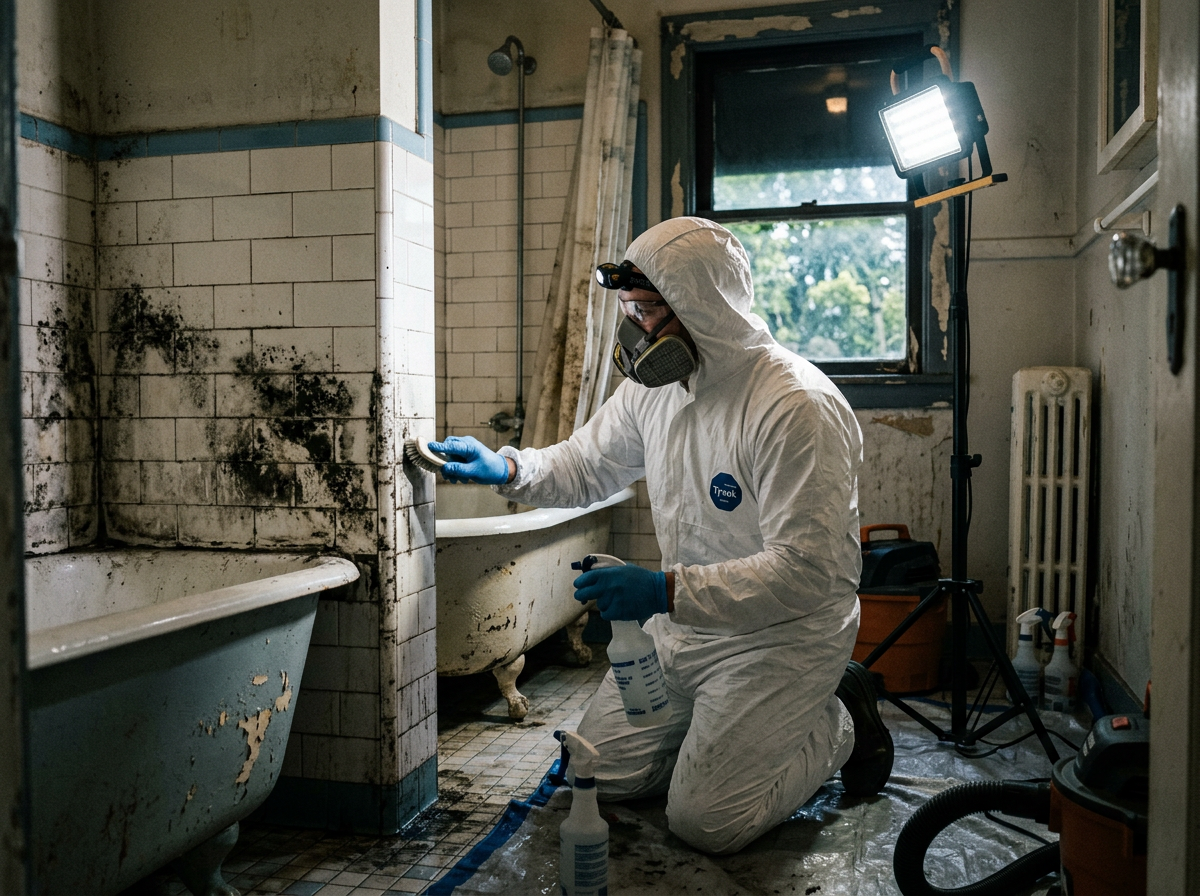
In western Washington bathrooms, mold typically appears along the north wall sheathing, in ceiling corners above showers, and behind vanities where constant humidity from daily showers meets inadequate exhaust. Nine months of maritime damp keeps drywall and grout from drying between uses, so growth spreads into the wall cavity once the paper facing stays wet for weeks. Technicians start by isolating the room, then remove affected drywall sections rather than surface cleaning alone because hidden studs and insulation behind tile often hold moisture that will restart the problem within months.
The real failure point on most jobs is exhaust fans that still vent into the attic or soffit instead of through the roof, plus missing or blocked damper flaps that let cold air and moisture back into the room. We trace plumbing leaks at tub surrounds and toilet bases first, then use moisture meters on adjacent rooms because stack effect pulls humid air from the bathroom into living spaces. Replacement materials must match the existing insulation depth and vapor retarder placement or the temperature difference on the north slope will cause condensation again the following winter.
Bathroom Mold Removal Near You — Choose Your City
Every city below has its own local Bathroom Mold Removal page with coverage details.
Snohomish County
Spokane County
Skagit County
Spokane
King County
Whatcom County
Snohomish
Wahkiakum County
Pierce County
Whatcom
Franklin
Benton
King
Franklin County
Skagit
Benton County
Pierce
Homeowners often try bleach or sprays on grout lines and caulk, but those products do not reach the back of the tile or the drywall behind the tub flange. Once the source moisture stays, new growth returns in the same pattern within one heating season. We limit work to visible and metered moisture areas, leaving untouched sections that test dry so the job stays contained and the structure is not opened unnecessarily.
Common Bathroom Moisture Sources
Washington bathrooms develop mold where shower steam meets cold exterior walls, where fan ducts terminate inside the attic, and where tub or toilet leaks saturate subflooring without a proper vapor barrier below. These conditions differ from eastern Washington jobs that usually trace to plumbing failures rather than chronic humidity.
Technician insight
In Lynnwood the most common miss on bathroom jobs is the 1970s-1980s split-levels where the bathroom shares a wall with the unconditioned garage; cold air leaks through the shared wall and keeps the back of the shower cold even after the fan runs, so growth returns on that one wall every winter until the gap is sealed.
North Lynnwood Split-Level Shower Wall
Growth kept returning on the north shower wall after repeated bleach cleaning. Inspection showed the exhaust fan venting into the attic and a small leak at the tub corner feeding the stud bay. We removed the affected drywall and insulation, re-terminated the fan through the roof, sealed the tub flange, and replaced materials with proper vapor retarder. The wall stayed dry through the following winter.
Bathroom Mold Removal Services We Offer
✓Shower and Tub Surround Remediation
Remove mold from tile, grout, and drywall behind the surround while sealing leaks at the flange and corners.
✓Exhaust Fan Re-Termination
Move bath fan ducts from attic or soffit to proper roof termination with backdraft damper to stop moisture recirculation.
✓Vanity and Sink Area Treatment
Inspect and treat cabinet bases, wall cavities, and supply lines where slow leaks keep wood and drywall damp.
✓Grout and Caulk Replacement
Remove contaminated grout and failed caulk then reinstall with mold-resistant materials after moisture sources are corrected.
✓Wall Cavity Drying and Insulation Check
Open affected cavities, dry framing, and replace insulation that stayed wet long enough to support growth.
How it works
- 1
Source Identification
Use moisture meters and visual inspection to locate active leaks, poor ventilation, and condensation points before any removal begins.
- 2
Containment and Removal
Isolate the bathroom, remove affected materials to the extent of measured moisture, and clean remaining surfaces.
- 3
Ventilation Correction
Re-terminate fans, clear blocked soffits, and confirm proper airflow so the space can dry between uses.
- 4
Restoration and Verification
Replace materials, apply new finishes, and recheck moisture levels to confirm the area stays dry.
Pricing
Scope depends on how far moisture has traveled into cavities and whether fan ducts or subflooring require correction; we provide a written quote after the inspection.