
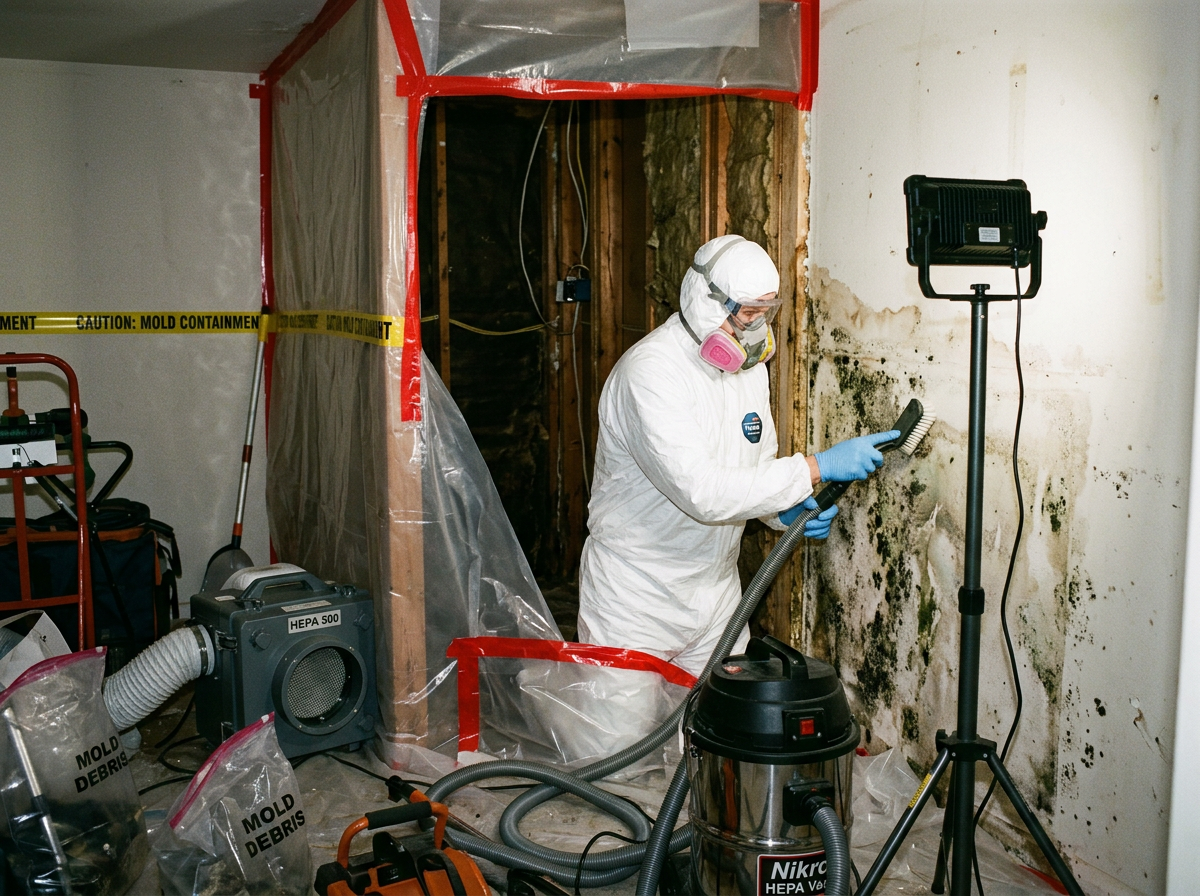
Attic mold in western Washington almost always starts with ventilation failure rather than a roof leak. Bath fans and dryer vents routed into the attic, insulation pushed over the eaves, and blocked soffit vents trap moisture against the cold north-facing sheathing. Nine months of maritime damp keeps wood and insulation from drying, so growth appears as dark staining along the upper slope first. Removal that stops at surface cleaning without correcting airflow simply restarts the cycle within one or two winters.
Technicians begin by isolating the attic, removing contaminated insulation, and cleaning sheathing with HEPA-vacuum and appropriate antimicrobial agents where the wood remains sound. When rot has penetrated more than surface depth or structural members show visible decay, sections of sheathing must be cut out and replaced. Encapsulation coatings applied over still-wet cavities or without restored airflow only hide the problem until the next heating season raises humidity again.
Mold Remediation Near You — Choose Your City
Every city below has its own local Mold Remediation page with coverage details.
Snohomish County
Spokane County
Skagit County
Spokane
King County
Whatcom County
Snohomish
Wahkiakum County
Pierce County
Whatcom
Franklin
Benton
King
Franklin County
Skagit
Benton County
Pierce
Eastern Washington jobs differ sharply; Spokane and Tri-Cities attics rarely see ventilation-driven mold. There the source is usually a plumbing vent leak or excessive indoor humidity from unvented appliances. Diagnosis therefore requires checking both the attic plane and the living-space moisture load before any material is disturbed.
Source Correction Steps
Restoring airflow means re-terminating bath and dryer ducts through the roof or gable, clearing every soffit bay, and installing proper baffles so insulation stays off the eaves. These changes are documented with before-and-after photos so homeowners can verify the work that actually stops recurrence.
Technician insight
In Lynnwood the thing that catches most people out with Mold Remediation is the 1970s-1990s split-levels where the original builder stuffed fiberglass right over the eaves and never vented the upstairs bath fan. Once winter sets in, that north slope stays wet for months and the mold keeps coming back until the soffits and fans are fixed.
Lynnwood Split-Level Attic
Bath fan vented into the attic and insulation blocking the soffits had kept the north sheathing damp for years. We removed saturated insulation, cleaned the sheathing, rerouted the fan through the roof, and cleared every soffit bay. Follow-up readings showed the attic now dries between rain events.
Mold Remediation Services We Offer
✓Sheathing Cleaning and Treatment
HEPA vacuuming and surface treatment of stained but structurally sound roof sheathing after insulation removal.
✓Bath and Dryer Fan Re-Termination
Rerouting existing exhaust ducts through the roof or exterior wall so moist air no longer enters the attic.
✓Soffit and Baffle Clearing
Removing insulation blockage and installing baffles to restore continuous airflow from eaves to ridge.
✓Insulation Removal and Replacement
Extraction of contaminated fiberglass or cellulose followed by installation of new material meeting current R-value codes.
✓Post-Remediation Verification
Independent visual inspection and moisture readings confirming the attic meets dry standards before insulation is replaced.
How it works
- 1
Inspection and Moisture Mapping
Technicians examine every accessible attic bay with moisture meters and note fan terminations, soffit conditions, and insulation placement.
- 2
Containment and Material Removal
Plastic barriers isolate the work area; wet or stained insulation is bagged and removed before sheathing cleaning begins.
- 3
Source Correction
Fans are re-terminated, soffits cleared, and baffles installed so the attic can dry between heating cycles.
- 4
Final Cleaning and Verification
HEPA vacuuming and surface treatment are followed by a third-party check that moisture levels have returned to normal.
Pricing
Final scope depends on square footage, depth of insulation saturation, and how many fan ducts or soffit bays require correction; call for an on-site assessment.